Household Active & Passive Rehabilitation Trainer —Upper & Lower Limb Home Cycle
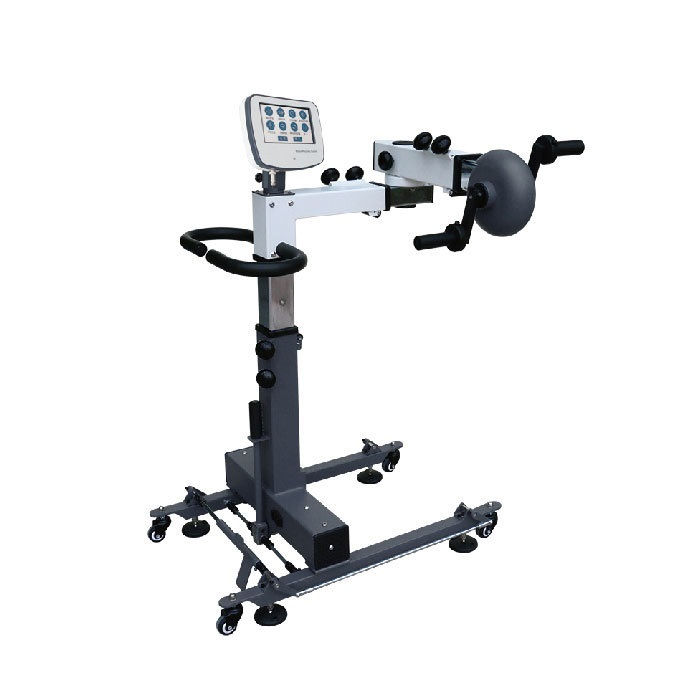
AE-H2000A is a household active and passive rehabilitation trainer designed specifically to bring clinical-quality upper and lower limb rehabilitation training into the patient's home. AE-H2000A is designed for home use and is easy to use and has comprehensive functions. It is designed based on ergonomics, combined with the theory of rehabilitation medicine, and drives patients to carry out goal-oriented and progressive rehabilitation training.
Three Training Modes — Active, Passive & Active-Passive : The H2000A has active, passive, and active-passive training modes — covering the complete continuum of patient functional capacity from the earliest stages of recovery through to advanced active strengthening:
1. Passive Mode — The device drives the patient's limb through a structured, repeatable range of motion without requiring any voluntary muscle effort. Passive mode is appropriate for patients in the earliest post-stroke or post-injury stage, when voluntary movement is minimal or absent — providing therapeutic range of motion maintenance, contracture prevention, and the sensory-motor input that begins the process of neural pathway reactivation, entirely at home.
2. Active Mode — The patient drives the movement independently, using the device to provide a structured, repeatable, and safely bounded exercise pattern for voluntary strengthening and coordination training. Active mode is used as the patient's voluntary motor capacity develops, providing a progressive strength and endurance training stimulus that can be performed consistently at home between clinic visits.
3. Active-Passive Mode — A blended mode in which the device provides assistance calibrated to the patient's own voluntary effort — amplifying and completing movement that the patient initiates but cannot fully complete alone. This mode is particularly valuable for the transitional recovery phase, encouraging maximal patient effort while ensuring that every repetition is completed correctly and safely, reinforcing the intention-matched motor learning that drives more effective neural pathway reconstruction than passive movement alone.
Simultaneous or Individual Upper & Lower Limb Training : It can train the upper and lower limbs individually or at the same time.
The H2000A's ability to train the upper and lower limbs either separately or simultaneously provides significant flexibility for a home rehabilitation programme tailored to the patient's specific recovery priorities and time availability. A patient with predominantly upper limb impairment can focus training sessions on arm and hand function; a patient with lower limb weakness following stroke can prioritise leg training for gait recovery preparation; and patients working on whole-body reconditioning can train upper and lower limbs simultaneously within a single session — improving the time efficiency and comprehensiveness of home-based training.
Limb Linkage Training — Solving High Muscle Tension Barriers
It can solve the problem of active rehabilitation training of the upper or lower limbs due to high muscle tension of the upper or lower limbs through the most basic limbs linkage training mode of the upper limb driving the lower limbs, the healthy side driving the affected side, and one limb driving the three limbs, the circular movement of the upper limb.
This linkage training capability addresses one of the most common practical barriers to home rehabilitation exercise: spasticity and high muscle tone in the affected limb that prevents the patient from initiating active movement independently, even when some voluntary capacity exists. The H2000A's linkage mechanisms provide several structured solutions:
Upper Limb Driving the Lower Limb — Voluntary movement initiated by the upper limb is mechanically transferred to drive movement of the lower limb — enabling lower limb training even when the lower limb itself cannot initiate movement due to high tone or weakness.
Healthy Side Driving the Affected Side — The patient's unaffected limb initiates and drives the movement of the affected limb — a bilateral training approach grounded in the same mirror-therapy and cross-education neurological principles used in clinical bilateral rehabilitation protocols, but delivered mechanically through the device rather than requiring a therapist's manual facilitation.
One Limb Driving Three Limbs — A single functioning limb can drive coordinated movement across the remaining three limbs — providing a training option for patients with severe multi-limb impairment where very few limbs retain sufficient voluntary control to initiate movement independently.
Circular Movement of the Upper Limb — A specific circular motion training pattern for the upper limb, supporting shoulder and elbow coordination training through a controlled, repeatable movement arc.
Interactive Games — Motivating Consistent Home Rehabilitation : The software provides situational interactive games to stimulate patients' interest in training, thereby enhancing muscle strength and improving balance and coordination.
This gamification serves a genuine therapeutic purpose beyond entertainment: the dual cognitive-motor engagement of game-based training has been shown to drive stronger neuroplastic adaptation than repetitive movement alone, while simultaneously improving the training adherence and session frequency that ultimately determine total rehabilitation training volume — the single strongest predictor of recovery outcome.
Real-Time Safety Monitoring — Protecting Patients During Unsupervised Use : Real-time monitoring to protect patient safety.
Because the H2000A is designed for use without a therapist physically present, built-in real-time monitoring is a critical safety feature that distinguishes it from generic home exercise equipment. The monitoring system tracks the patient's movement and physiological response parameters during each session, providing the safety oversight that would otherwise require direct clinical supervision — enabling family caregivers and patients to use the device with confidence that abnormal patterns or safety-relevant events during training are detected and addressed appropriately.
Quantity
Technical Specifications
• The structural design is more suitable for home use and helps more patients recover.
• Diverse training methods : Add upper and lower limb collaborative training and upper and lower limb free training modes.
• Intelligent control : The device has Bluetooth function. After connecting to the mobile phone, it can be controlled directly by APP. It is easy to operate and has comnprehensive functions.
Technical Parameters :
Weight : 20Kg
Resistance : Adjustable from 0 to 20 levels, in steps of 1
Dimension : 6900mm x 460mm x 1130mm
Speed : 1~60 rpm, step is 1
Height : 0~70mm
RELATED PRODUCTS