Robotic Gait Training and Evaluation System-Five-Axis Physiological GaitRehabAI1
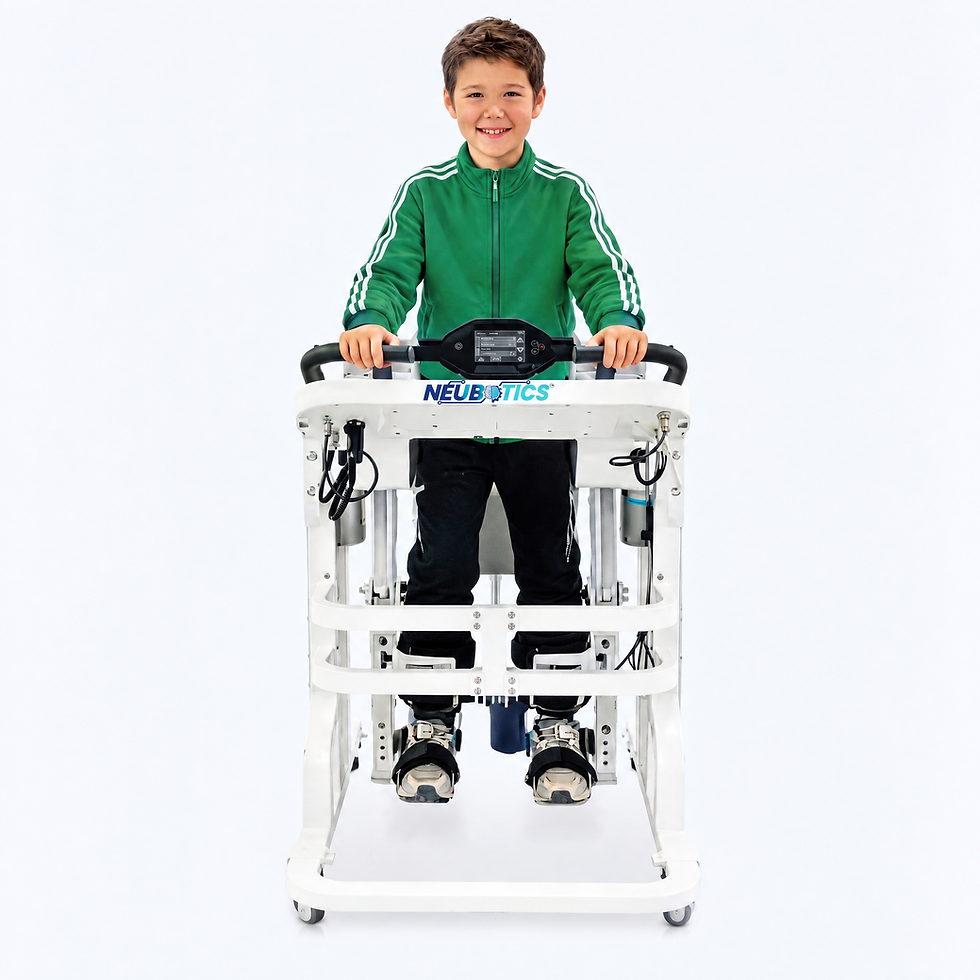
The AI1 Gait Training and Evaluation System is a hospital-grade AI rehabilitation robot for the systematic, high-volume, physiological gait training of patients with neurological, musculoskeletal, and age-related walking impairment. Based on the clinically validated principle of neural plasticity, the AI1 uses five-axis linkage robotic mechanical legs to guide patients through precisely simulated physiological gait patterns — completing the large number of repetitive, correctly-formed gait cycles required to establish new motor pathways and restore functional walking ability.
Five-Axis Linkage Technology — Autonomous, Adaptive Gait Guidance
The AI1's five-axis linkage mechanism is the engineering core of its clinical effectiveness. Five independent motorised axes — spanning hip flexion-extension, knee flexion-extension, and ankle dorsiflexion-plantarflexion across both lower limbs — operate in coordinated linkage to produce a three-dimensional, multi-joint gait pattern that faithfully replicates the biomechanics of normal human walking.
Three Training Modes — Passive, Assisted & Active (Free Switching) :
- Passive Mode — The robotic system guides the patient's lower limbs through the complete gait cycle without requiring any voluntary motor effort from the patient. In passive mode, the five-axis linkage provides all the mechanical force required to complete each stride — the patient's legs are moved through physiological gait while they focus on the sensory experience of normal walking mechanics. Passive mode is indicated from the earliest stages of post-stroke or post-surgical gait rehabilitation, when voluntary lower limb movement is absent or severely limited.
- Assisted (Helpful) Mode — The system detects the patient's voluntary motor effort and provides precisely calibrated supplementary assistance to complete each gait cycle — amplifying the patient's own motor commands rather than overriding them. This mode bridges passive and fully active training: the robot follows the patient's movement intention, adding enough force to achieve a complete, correctly-formed gait cycle, while progressively reducing the assistance level as the patient's voluntary output increases.
- Active Mode — The patient drives gait independently, with the robotic system providing safety support and guidance but no active assistance. Active mode challenges the patient to generate and control the full mechanical requirements of walking within the support environment of the AI1 — providing the progressive, high-challenge practice that drives the final stages of gait recovery toward functional independence.
- Human-Computer Interactive Training — Virtual Reality Environment : The AI1 integrates virtual reality human-computer interaction with the robotic gait training platform — creating an immersive, engaging therapeutic environment that addresses one of the most significant clinical challenges in gait rehabilitation: patient motivation and active cognitive engagement during repetitive training.
- AI Mirror Gait Learning Assessment : The AI1's AI mirror gait learning assessment is a machine learning-based gait analysis capability that distinguishes it from purely mechanical gait trainers. The system continuously acquires and analyses the patient's gait pattern data across training sessions.
- Gait Possibility Expansion — By learning the range of gait variations within the patient's movement data, the AI generates alternative gait pathway options that expand the training stimulus beyond a single fixed template — exposing the patient's nervous system to a richer variety of physiologically valid gait patterns and stimulating broader neural pathway recruitment.
- Personalised Training Optimisation — The AI model enables the system to predict and respond to the patient's likely movement at each phase of the gait cycle — adapting the assistance level, timing, and guidance force parameters based on learned patient-specific data rather than population-average defaults
| Specification | Detail |
|---|---|
| Category | AI Rehabilitation Robot / Robotic Gait Training System |
| Technology | Five-axis linkage, dynamic weight support, longitudinal CoG augmentation |
| Training Modes | Passive / Assisted / Active (free switching, real-time adjustment) |
| AI Features | Mirror gait learning assessment, adaptive perception, automatic human motion matching |
| Interaction | VR human-computer interactive training |
| Patient Management | Individual profiles, evaluation, recording, reporting, monitoring |
| Dimensions | 2960 × 1570 × 2650 mm |
| Net Weight | 600 kg |
| Certifications | CE Certified, ISO Certified |
| Clinical Application | Neurological, musculoskeletal, elderly gait rehabilitation |
| Setting | Hospital rehabilitation departments, neuro-rehab centres, physical therapy clinics |
Quantity
Frequently Asked Questions
Q: What is "five-axis linkage" and why does it matter clinically?
A: Five independent motorised axes — spanning hip flexion-extension, knee flexion-extension, and ankle dorsiflexion-plantarflexion across both lower limbs — operate in coordinated linkage to produce a three-dimensional, multi-joint gait pattern. This matters because authentic human walking involves precisely coordinated multi-joint movement — a device that only moves one or two joints, or moves joints independently without coordination, cannot replicate physiologically correct gait. The AI1's five-axis coordination ensures every repetition trains the correct, integrated movement pattern rather than an isolated or artificial substitute movement.
Q: What does "AI mirror gait learning assessment" mean?
A: This function captures and analyses the patient's gait pattern — comparing the affected limb's movement characteristics against a "mirrored" reference derived from the unaffected limb or normative data — to objectively quantify specific gait asymmetries and deviations. This data-driven analysis informs precisely targeted training parameter adjustment rather than relying solely on subjective visual observation of gait quality.
Q: What conditions is the AI1 suitable for?
A: The AI1 is indicated for retraining of walking function in neurological disorders — cerebral stroke, TBI, Parkinson's disease, spinal cord injury, multiple sclerosis — and for recovery of lower limb function in musculoskeletal conditions including post-prosthetic replacement, disuse muscle weakness, degenerative joint disease, and lower limb muscle wasting, as well as reconstruction of walking function in elderly and disabled patients.
Q: How does the AI1 differ from the AI3 Lower Extremity Feedback Training System?
A: The AI1 is a gait training robot using mechanical legs to guide patients through physiologically simulated walking movement — the primary application is restoring the walking movement pattern itself. The AI3 provides ultra-early lower extremity interventional rehabilitation across the lying-sitting-standing progression, with a multi-position ergonomic curve bed and adjustable guiding force across passive, power-assisted, and active modes — focused on the earliest stages of lower limb rehabilitation before or alongside gait-specific training on the AI1.
Q: What training modes does the AI1 offer?
A: The AI1 offers passive mode (full mechanical assistance for patients with minimal voluntary movement), assisted/adaptive mode (adjustable assistance matched in real time to the patient's voluntary contribution), and active mode (the patient drives gait independently, with the robotic system providing safety support and guidance but no active assistance).
RELATED PRODUCTS