Swing Gait Trainer — Standing & Walking Rehabilitation with Synchronous Training
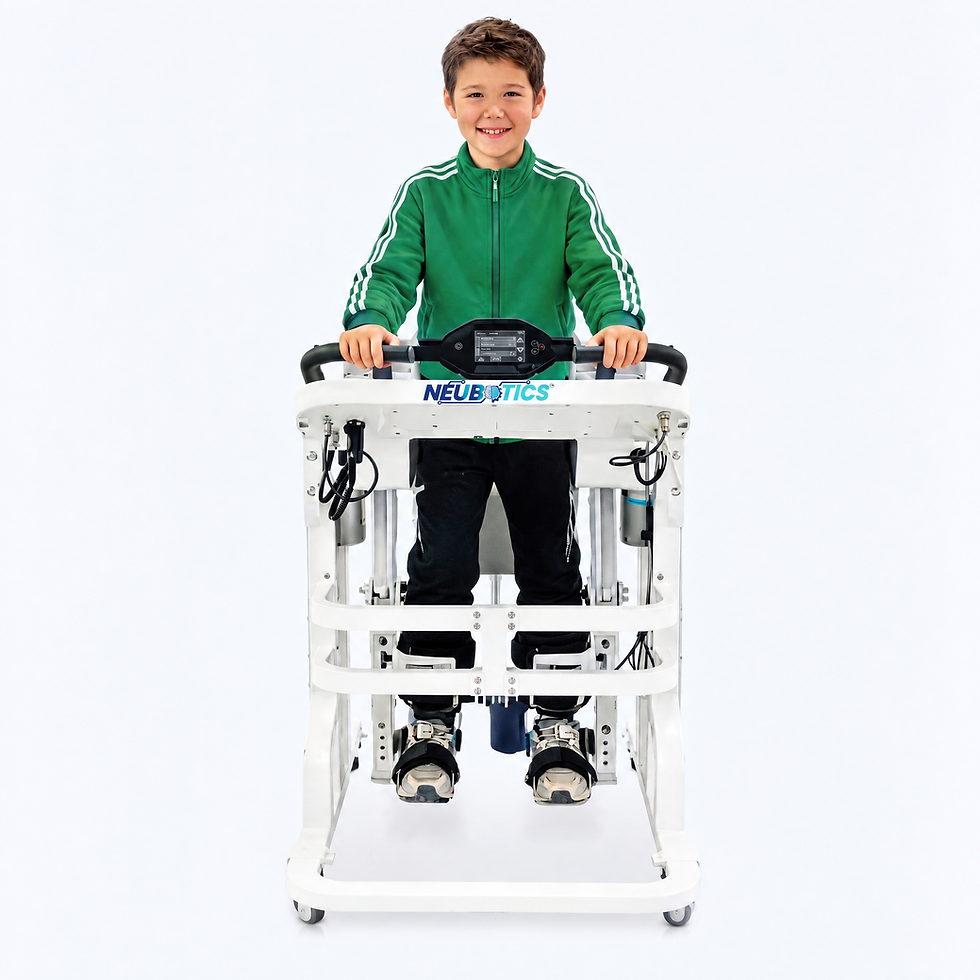
The NEUBOTICS Swing Gait Trainer is a standing and walking rehabilitation device from Kiyash Healthcare Pvt. Ltd., designed to restore the fundamental mechanics of upright weight-bearing and gait through a synchronous, bilaterally-linked swing mechanism. The patient drives the synchronous training of the affected side through the movement of the healthy side — simulating the load system of normal bones, performing standing walking training, and providing a solid support system throughout.
Key Features —
Synchronous Training — Healthy Side Driving the Affected Side : The KB101's core rehabilitation mechanism is bilateral synchronous swing motion — the patient drives the synchronous training of the affected side through the movement of the healthy side. This linked, mechanically-coupled movement between the unaffected and affected limbs is a clinically important approach for patients with unilateral weakness, hemiplegia, or asymmetric lower limb function following stroke or neurological injury.
By mechanically coupling the two sides of the body, the device ensures that the affected limb is moved through a physiologically correct range and pattern that mirrors the voluntary movement of the healthy side — providing consistent, repeatable, bilaterally symmetric input to the affected limb even when that limb cannot independently generate the same quality of movement. This synchronous coupling reflects the same neurological principle underlying bilateral and mirror-based rehabilitation techniques used more broadly in stroke recovery.
Simulating the Normal Bone Load System — Why Weight-Bearing Matters : One of the most important components of gait rehabilitation is restoring the correct axial load-bearing pattern through the lower limb skeleton. Normal standing and walking depend on the femur, tibia, and foot bearing body weight through a specific, biomechanically efficient alignment; after stroke, prolonged bed rest, or lower limb injury, patients frequently lose the neuromuscular control needed to maintain this correct load-bearing alignment, leading to compensatory postures, joint stress, and unsafe standing mechanics.
The KB101 is specifically engineered to simulate this normal skeletal load-bearing system during training — guiding the patient's weight through the lower limb in a physiologically correct pattern rather than allowing the compensatory malalignment that unsupported or poorly guided standing practice can reinforce.
Correcting Abnormal Gait & Inhibiting Primitive Reflexes : Correct the patient's abnormal gait, inhibit abnormal and primitive reflex activities, and rebuild normal movement patterns.
Following stroke and other central nervous system injuries, patients frequently develop compensatory gait patterns and exhibit the re-emergence of primitive reflex activity — involuntary reflex movement patterns that are normally suppressed by mature central nervous system control but can resurface when the descending inhibitory pathways are damaged. These abnormal reflex patterns and compensatory gait deviations, if left unaddressed, become reinforced through repetition and increasingly difficult to correct as the patient's nervous system adapts to and consolidates the abnormal pattern rather than the normal one.
The KB101 structured, guided, symmetric movement training is specifically designed to counteract this process — providing the consistent, correctly-formed movement input needed to inhibit abnormal reflex activity and progressively rebuild the normal movement patterns that support independent, functional, and safe walking. This corrective function is most valuable earlier in the rehabilitation timeline, before compensatory patterns become deeply established, making the KB101 a particularly important tool in the early-to-mid phase of post-stroke gait rehabilitation.
Beyond Gait — Improving Coordination & Cognitive Function : Improve the patient's overall coordination and cognitive function.
The KB101's therapeutic benefit extends beyond the purely biomechanical restoration of gait mechanics. The coordinated, bilaterally-synchronised movement pattern required to use the device engages broader motor coordination networks — the timing, sequencing, and inter-limb coordination that underlies not just walking but a wide range of functional movement tasks. Additionally, the active engagement, attentional demand, and motor planning required during structured standing and walking practice contribute to cognitive function benefits that are increasingly recognised as an important secondary outcome of physical rehabilitation in stroke and neurological populations — reflecting the well-established interdependence of motor and cognitive recovery processes in the post-stroke brain.
Quantity
Clinical Applications — Who Is the KB101 For ?
Stroke Rehabilitation (Hemiplegia) — Patients with unilateral lower limb weakness following stroke are the primary indicated population — benefiting specifically from the synchronous healthy-side-driving-affected-side mechanism that provides consistent, correctly-formed movement input to the affected limb.
Early-Stage Gait Rehabilitation — Patients who have not yet developed sufficient independent standing balance and lower limb control for unsupported gait training, but who are ready to begin structured, supported standing and walking practice.
Patients with Abnormal Reflex Activity — Neurological rehabilitation patients exhibiting primitive reflex re-emergence or abnormal compensatory gait patterns that require structured, corrective movement training to address before they become further entrenched.
Traumatic Brain Injury and Other Central Neurological Conditions — Any condition producing asymmetric lower limb weakness, abnormal load-bearing mechanics, or gait pattern deviation where synchronous bilateral training and supported standing practice would be clinically beneficial.
Post-Immobilisation Deconditioning — Patients recovering from prolonged bed rest or lower limb immobilisation who require structured re-education of normal weight-bearing mechanics before progressing to independent gait training.
RELATED PRODUCTS