Robowalk 3000 — Robotic Exoskeleton Rehabilitation Robot for Lower Limb
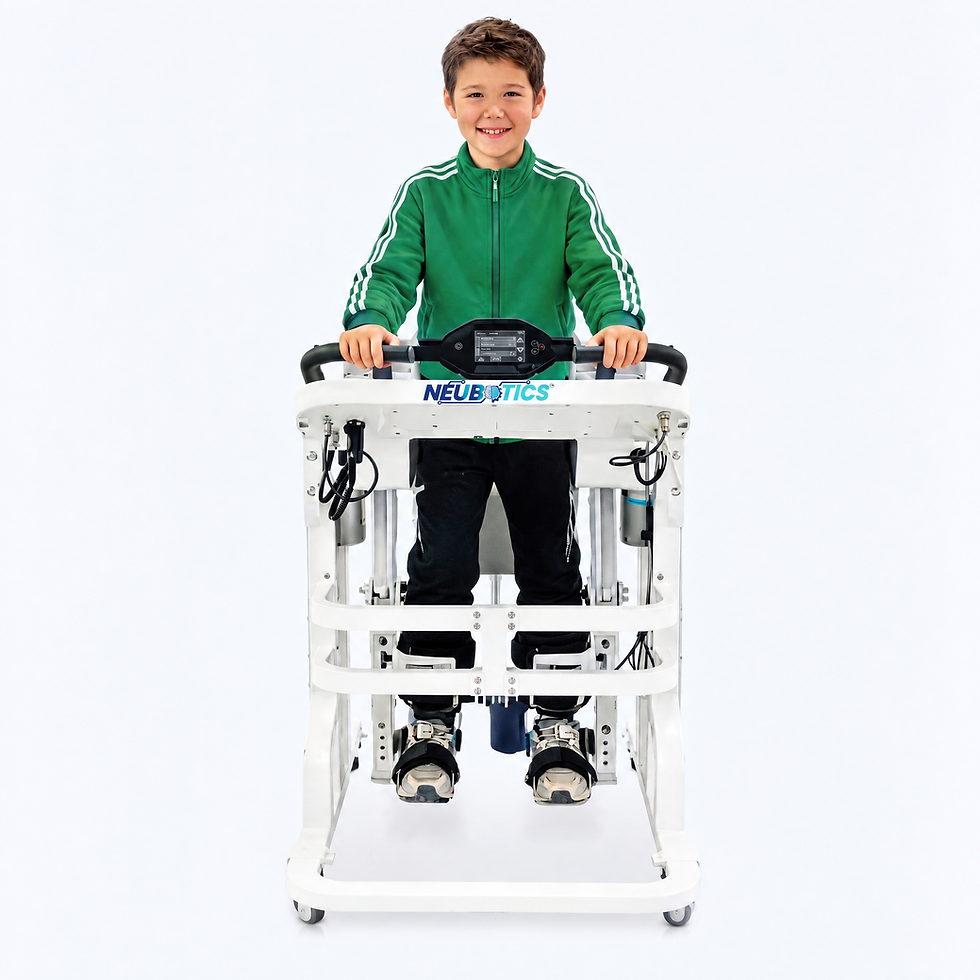
The Neubotics Robowalk 3000 is a robotic exoskeleton rehabilitation robot designed to help patients with lower limb paralysis, weakness, or gait impairment relearn how to walk. Combining motorized joint actuation with multiple training modes, Robowalk 3000 enables physiotherapists to deliver structured, high-repetition, physiologically correct gait training — the type of intensive practice that neurological recovery depends on, but that manual therapist-assisted walking simply cannot deliver at scale. Whether deployed in a hospital rehabilitation department, a specialist neurological rehabilitation centre, or an outpatient physiotherapy clinic, Robowalk 3000 brings robotic exoskeleton rehabilitation technology within reach of institutions that need a reliable, clinically effective gait training solution for their stroke, spinal cord injury, and neurological patient populations.
Accelerate recovery and restore mobility with the NEUBOTICS 3000-Step Lower Limb Exoskeleton Robot - Robowalk, a state-of-the-art locomotor rehabilitation device engineered for high-intensity, repetitive gait training. Designed to stimulate neural remodeling and rebuild muscle strength, this wheeled physiotherapy system safely assists patients in transitioning from sitting to standing, and standing to walking.
Why Choose Robotic Exoskeleton Rehabilitation?
Traditional manual gait rehabilitation depends entirely on therapist strength, stamina, and availability — a single physiotherapist can typically guide a patient through only 30–50 assisted steps before fatigue limits further progress. Robotic exoskeleton rehabilitation removes this ceiling entirely. Robowalk 3000 enables patients to complete hundreds of correctly formed gait cycles in a single session — the high-repetition, task-specific practice that motor learning research consistently identifies as the single strongest driver of neurological gait recovery.
This isn't just about doing more steps. It's about doing the right steps, every time — Robowalk 3000's motorized hip and knee joint actuation guides each patient through a biomechanically accurate walking pattern, helping the nervous system relearn correct movement rather than reinforcing the compensatory, asymmetrical gait patterns that often develop after stroke or injury.
Key Features —
- Motorized Hip & Knee Joint Actuation — Powered actuators drive the lower limbs through a physiologically accurate gait cycle, assisting patients who cannot yet generate sufficient voluntary movement to walk independently.
- Multiple Training Modes — Passive mode for patients with minimal voluntary movement, active-assisted mode that responds to the patient's own effort, and active/resistance mode for patients progressing toward independent walking.
- Adjustable Frame — Accommodates a range of patient heights and body dimensions for fast, accurate fitting between patients.
- Body Weight Support Compatible — Designed to work alongside overhead or walker-based body weight support systems, enabling safe gait training even for patients who cannot yet bear their full body weight.
- Safety Systems — Fall detection, emergency stop, and joint range limiters protect patients throughout every session
- High-Repetition Training Capacity — Enables far more complete gait cycles per session than manual therapist-assisted walking, accelerating the pace of rehabilitation
- Real-Time Gait Parameter Control — Walking speed, assistance level, and step parameters are all adjustable, allowing therapists to precisely prescribe and progress each patient's training.
Clinical Applications —
Stroke (CVA) Rehabilitation : Robowalk 3000 enables stroke patients with hemiplegia or significant lower limb weakness to complete structured, repetitive gait training from the earliest appropriate rehabilitation stage — supporting the neuroplastic recovery process that restores independent walking.
Spinal Cord Injury (SCI) : For patients with incomplete spinal cord injury, robotic exoskeleton rehabilitation provides the intensive, repetitive locomotor training that helps activate residual neural pathways and rebuild functional walking capacity.
Traumatic Brain Injury (TBI) : Structured gait training following TBI supports motor pathway reorganisation during the critical early and mid recovery phases, when high training volume has the greatest impact on long-term outcomes.
Parkinson's Disease : Consistent, externally guided gait training can help address the reduced stride length, shuffling gait, and freezing episodes commonly seen in Parkinson's disease.
Multiple Sclerosis : Adaptive, adjustable-intensity gait training accommodates the fluctuating strength and fatigue levels typical of MS, supporting maintenance and improvement of walking function.
Post-Surgical & Orthopaedic Rehabilitation : Following major lower limb surgery or prolonged immobilisation, guided gait training helps patients safely rebuild walking confidence and correct movement patterns.
Why Robotic Exoskeleton Rehabilitation Delivers Better Outcomes —
The clinical case for robotic exoskeleton rehabilitation rests on a simple principle: walking recovery requires walking practice — a lot of it, done correctly, on a consistent basis. Manual therapy alone cannot deliver this volume of practice without exhausting the therapist within minutes. Robowalk 3000 solves this by taking over the physically demanding work of guiding and supporting the patient's legs through each step, freeing the physiotherapist to focus entirely on what only a trained clinician can do — observing gait quality, giving verbal and tactile feedback, and adjusting the treatment plan in real time.
This combination — robotic consistency plus expert clinical oversight — is what makes robotic exoskeleton rehabilitation one of the fastest-growing approaches in modern neurological and orthopaedic rehabilitation worldwide.
Quantity
Frequently Asked Questions
Q: What is robotic exoskeleton rehabilitation?
A: Robotic exoskeleton rehabilitation uses a wearable, motorized device to guide a patient's legs through a correct walking pattern, enabling high-repetition gait practice for patients who cannot yet walk independently due to stroke, spinal cord injury, or other neurological conditions.
Q: Which conditions is Robowalk 3000 suitable for?
A: Robowalk 3000 is designed for patients with stroke, spinal cord injury, traumatic brain injury, Parkinson's disease, multiple sclerosis, and other conditions affecting lower limb walking function.
Q: Can Robowalk 3000 be used by patients who cannot walk at all?
A: Yes. Passive mode allows the device to guide a patient's legs through the full gait cycle even with zero voluntary movement, making it suitable for patients at the earliest stages of rehabilitation.
Q: Is physiotherapist supervision required?
A: Yes. Robowalk 3000 is a clinical rehabilitation device intended for use under trained physiotherapist supervision, particularly during initial sessions and whenever the patient is at elevated fall risk.
Q: Does Robowalk 3000 work with body weight support systems?
A: Yes, the device is designed to be compatible with overhead or walker-based body weight support systems for patients who cannot yet bear their full body weight.
Q: Is training available for our clinical staff?
A: Yes, Upon installation, our dedicated Sales and Service Engineers will conduct a comprehensive training session for your clinical staff. This training will thoroughly cover the machine's operational mechanisms, safety protocols, and standard operational procedures to ensure seamless integration into your daily workflow.
Q: What is the warranty and after-sales support?
A: The machine is covered by a standard one-year comprehensive warranty, which includes full coverage for all system components, expressly excluding instances of physical damage or user mishandling.
RELATED PRODUCTS