Upper Extremity Feedback Training and Evaluation System (AE-AI2)
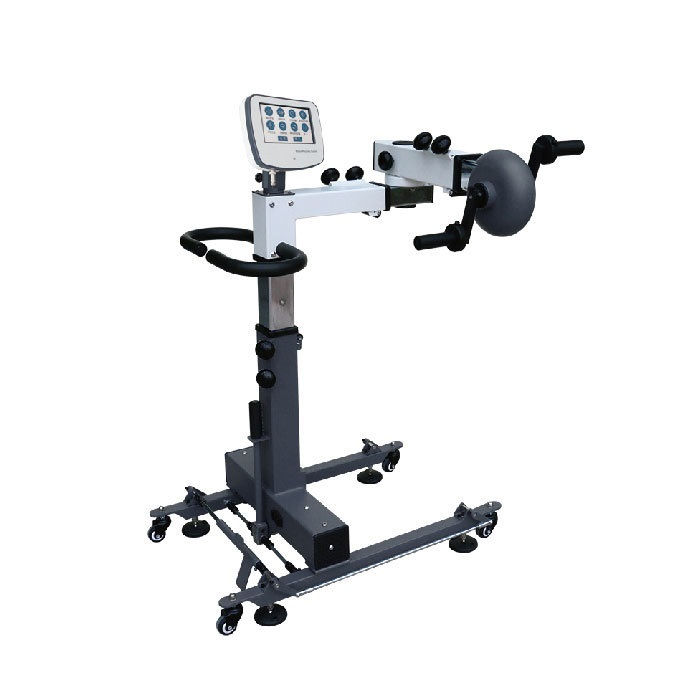
The AE-AI2 is an ergonomically engineered robotic upper limb rehabilitation and evaluation system, part of Kiyash Healthcare's AI Rehabilitation Robot series. The adjustable upper limb weight reduction manipulator based on ergonomics provides patients with training and evaluation in three-dimensional space — combining a 6 degrees-of-freedom (6-DOF) robotic manipulator, built-in scenario biofeedback games, and standardized evaluation tools to accurately analyze and evaluate patients' abilities, accelerating the process of upper limb rehabilitation and neurological recovery.
Key Features —
- 6-DOF Robotic Manipulator — Full Three-Dimensional Movement : The 6-DOF manipulator can adjust one-dimensional motion of single joint and two-dimensional and three-dimensional motion of multiple joints as required. This six-degrees-of-freedom architecture allows the device to guide isolated single-joint movement (for example, elbow flexion/extension alone) as well as complex, multi-joint, three-dimensional reaching and functional movement patterns that more closely replicate real-world activities of daily living — a critical distinction from simpler single-axis rehabilitation devices that can only move the limb along one fixed plane.
- Adjustable Weight Reduction (Gravity Support) : The adjustable upper limb weight reduction manipulator compensates for the weight of the patient's own arm during training — allowing patients with significant weakness, who could not otherwise lift or move their arm unassisted, to actively participate in guided movement. As strength returns, the level of weight support can be reduced, allowing the training protocol to progress in difficulty alongside the patient's recovering function.
- Grip Strength Feedback : The weight reduction device and grip strength feedback system can compensate the strength and collect the grip strength according to the actual needs of the upper arm and the lower arm. Integrated grip strength measurement allows hand function — often significantly impaired in stroke and neurological conditions — to be objectively tracked alongside proximal arm movement, giving clinicians a more complete picture of upper limb recovery than arm movement training alone would provide.
- Scenario Simulation Biofeedback : Built-in incentive feedback games and standardized evaluation tools transform guided robotic movement into interactive, game-based training. Real-time visual feedback on screen keeps patients engaged with their own performance during each repetition — a well-established strategy in neurorehabilitation for maintaining patient motivation and treatment adherence across the many sessions required for meaningful functional recovery.
- One-Key Left/Right Arm Switching : Exclusive upgrade of left and right arm replacement technology, one key switching of left and right arms, intelligent recognition and training of arm side, and improvement of therapist's work efficiency. Rather than requiring manual reconfiguration or a separate device setup for the affected side, the ZEPU-AI2 allows the therapist to switch between left-arm and right-arm training configurations with a single control action — reducing session setup time and supporting efficient patient throughput in busy rehabilitation departments.
- Wireless Data Transmission : Wireless transmission technology is adopted, which is beautiful and convenient — eliminating cable clutter around the patient and workstation, simplifying the clinical environment, and supporting a cleaner, more modern treatment room setup.
- Patient Management & Course Tracking : Integrated patient information and course management software supports patient management, prescription formulation, functional training and evaluation tools — enabling clinicians to document treatment plans, track progress across multiple sessions, and build an objective evidence base of functional improvement over the course of a rehabilitation programme.
Technical Specifications —
Specification | Detail |
|---|---|
| Degrees of freedom | 6-DOF robotic manipulator |
| Movement modes | 1D single-joint, 2D and 3D multi-joint |
| Weight support | Adjustable upper limb weight reduction |
| Grip strength feedback | ✅ Yes — compensates and measures grip strength |
| Arm side switching | One-key left/right switching with automatic recognition |
| Data transmission | Wireless |
| Biofeedback training | ✅ Built-in scenario simulation games |
| Patient management software | ✅ Yes — course and prescription tracking |
| R&D centre | Bremen, Germany |
| Aftersales service centre | Bremen, Germany |
| Production base | Gaomi Hi-Tech Industrial Development Zone, Shandong, China |
Quantity
Frequently Asked Questions
Q: What conditions is the AE-AI2 designed to treat?
A: The AE-AI2 is indicated for remodeling of upper limb daily living ability in neurological diseases (such as stroke), shoulder subluxation and shoulder-hand syndrome, arthritis of the upper limb and post-fracture rehabilitation, disuse syndrome in the elderly, and general upper limb degenerative conditions requiring improved muscle strength and endurance.
Q: How does the 6-DOF manipulator differ from simpler rehabilitation devices?
A: A 6 degrees-of-freedom manipulator can move and guide the patient's arm through complex, multi-joint, three-dimensional patterns — rather than being restricted to a single fixed plane of movement as simpler single-axis devices are. This allows training to progress from isolated single-joint exercises to more complex, functional reaching and movement patterns that better reflect real-world arm use.
Q: Can the same device be used for both the left and right arm?
A: Yes. The AE-AI2 features one-key switching between left and right arm configurations, with intelligent recognition and training of the selected arm side — allowing therapists to reconfigure the device quickly between patients or between affected and unaffected side training.
Q: Does the AE-AI2 measure patient progress objectively?
A: Yes. The system includes standardized evaluation tools and grip strength feedback measurement, combined with patient management software for prescription formulation and course tracking — supporting objective, documented monitoring of functional improvement across a treatment programme.
RELATED PRODUCTS