Hospital Hand Rehabilitation Robot Glove — 10-Mode Full-Cycle Stroke Recovery
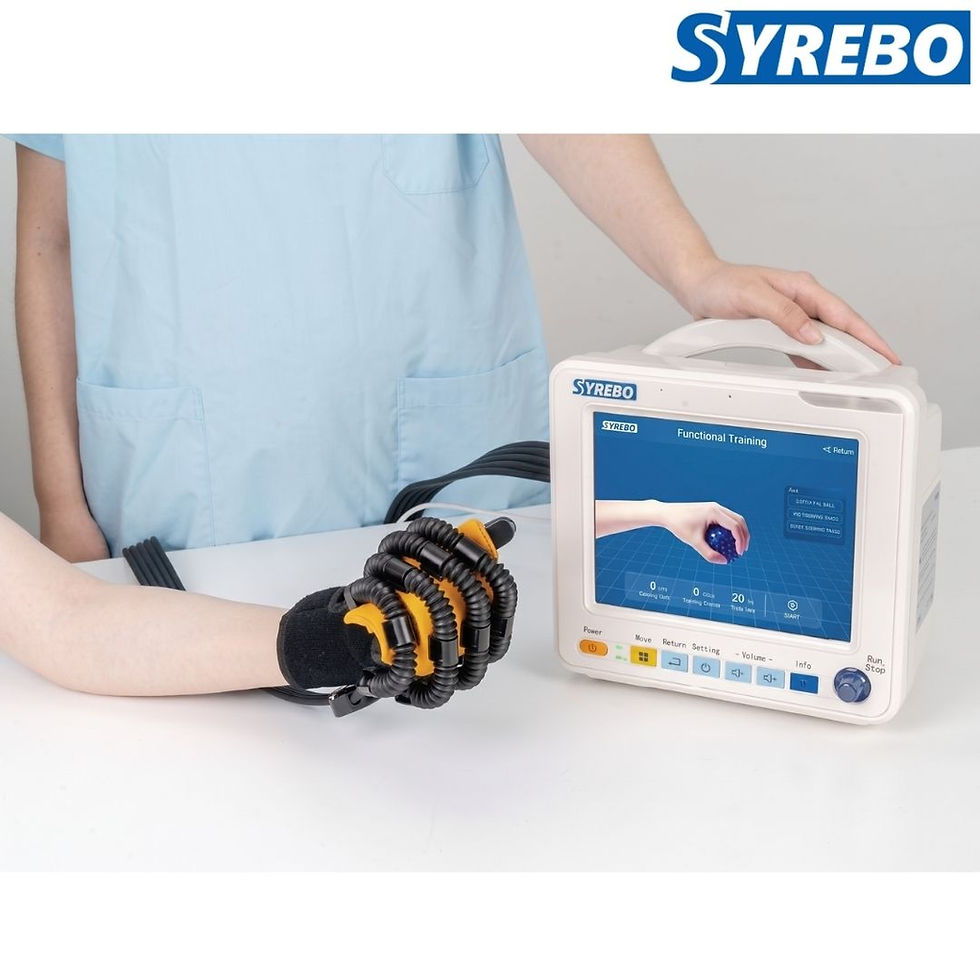
The Syrebo SY-HR08E Hand Rehabilitation Robot Glove is Syrebo's most advanced, hospital-grade soft robotic hand therapy system. The SY-HR08E delivers 10 comprehensive training modes grounded in four internationally validated neurorehabilitation theories.
Purpose-built for hospital rehabilitation departments, stroke units, and specialist physiotherapy clinics, the SY-HR08E covers every stage of the hand recovery journey — from the super-early acute phase (within 3 days of stabilisation) through to postoperative functional rehabilitation — using soft robotic technology, AI-assisted motor intention detection, anti-spasm safety systems, and gamified strength training.
FDA Registered | CE Certified | Clinically validated in 3,000+ hospitals
4 Rehabilitation Theories — The Clinical Science Behind SY-HR08E
1. Motor Relearning Programme (MRP) Theory The SY-HR08E delivers high-volume, structured repetition so patients fully experience the correct motor sensation at every stage — from simple single-finger movements to coordinated multi-muscle actions — accelerating central motor control recovery.
2. Bilateral Synergy (BS) Theory Symmetrical simultaneous movement of bilateral muscle groups activates similar neural networks in both cerebral hemispheres. The SY-HR08E's bilateral mirror training mode operationalises this principle: when a symmetrical movement is completed, the same motor parameters are communicated through neural pathways in both hands, progressively strengthening motor recovery in the affected limb through neuronal cross-hemisphere communication.
3. Motor Imagery (MI) Theory Clinically proven as one of the most effective methods for hemiplegia rehabilitation, Motor Imagery therapy combined with conventional training has a synergistic effect — significantly improving FMA (Fugl-Meyer Assessment), MAS (Modified Ashworth Scale) scores, and upper limb muscle strength in stroke patients with hemiplegia.
4. Central-Peripheral-Central (CPC) Closed-Loop Rehabilitation Theory All 10 training modes of the SY-HR08E are designed to maintain this closed-loop engagement — activating the motor cortex (central) while driving peripheral hand movement, and feeding proprioceptive and visual feedback back to the brain to close the loop.
10 Training Modes — Complete Clinical Coverage
1. Passive Training The rehabilitation glove drives the affected hand through automatic flexion and extension without patient effort. Flexion and extension timing parameters are individually adjustable to match patient muscle tone, spasticity level, and stage of recovery. Indicated from the super-early stage through the paralysis phase.
2. Fine Motor Training Patients complete designated active gesture training guided by on-screen prompts. Movement parameters are incrementally adjusted to progressively challenge finger coordination, dexterity, and central motor control. Combined with upper limb motor control training, this mode transitions patients from passive recipients of therapy to active, self-directed rehabilitation participants.
3. Passive Training + Task-Oriented Training Passive robotic glove movement is combined simultaneously with task-oriented hand function training and active-passive consciousness exercises. This early integration of sensory input and motor intent has been shown to enhance the reconstruction of damaged motor conduction pathways and accelerate functional hand recovery — a mode unique to the HR08E among the Syrebo clinical range.
4. Assistance Training A built-in muscle force sensor captures the patient's subtle voluntary muscle contraction signals, intelligently recognises motor intention, and provides precisely calibrated assistive force to complete the full range of joint movement. This mode bridges pure passive therapy and active training, encouraging active participation at the earliest possible recovery stage.
5. Bilateral Mirror Training The healthy hand drives the affected hand through synchronised, symmetrical movement. Simultaneous visual effects and proprioceptive feedback — seeing and feeling both hands move in concert — powerfully activate mirror neuronal networks in both cerebral hemispheres, strengthening neural communication between hemispheres and accelerating neuroplasticity-driven motor recovery in the affected side.
6. Resistance Training The patient performs voluntary hand movement while the glove applies controlled opposing force, requiring active muscular effort to complete flexion and extension against resistance. Resistance is available in two calibrated intensity levels — Low and Strong — enabling therapists to match resistance to each patient's individual recovery stage and muscular capacity, building grip strength and endurance progressively without overloading recovering tissue.
7. Interactive Game Training Multi-interactive hand and brain combined games stimulate patient engagement, cognitive participation, and active motor effort. Game training paired with upper limb motor control principles converts passive participants into motivated, active learners — improving treatment adherence, willingness to train across multiple daily sessions, and cortical motor control recovery through dual motor-cognitive engagement.
8. Manual Training A hand-held switch in the healthy hand gives the patient direct control over the grip and release of the dysfunctional hand. This mode supports patient autonomy, builds confidence in hand control, and provides a transitional training modality between therapist-directed and fully self-directed rehabilitation.
9. Strength & Coordination Evaluation An integrated clinical assessment module incorporates scale-based coordination and strength assessment to provide objective, data-driven guidance for rehabilitation treatment planning. Automated reports track rehabilitation progress, document clear trends of change over time, and generate evidence for treatment plan adjustments — supporting closed-loop clinical management and outcomes documentation for institutional settings.
10. Pinch Grip Force Game Training Using a grip gauge on the affected hand, patients engage in strength-specific game training with individually set target force levels. Progressive target strengthening builds muscle strength in measurable, trackable increments. Game integration maintains patient motivation and engagement during what would otherwise be repetitive isometric strengthening exercises — accelerating functional grip recovery through gamified force training.
Anti-Spasm Safety System
The SY-HR08E includes a dedicated anti-spasm mode specifically designed for patients in the spastic phase of stroke recovery (high muscle tone). Key safety features include:
Pressure pump force limiting — Prevents excessive pneumatic force from being applied to a spastic hand, avoiding secondary injury
Slow, graduated flexion-extension — Tone-reducing speed profiles ensure controlled, gentle movement that reduces muscle tension rather than triggering increased tone
Clinical contraindication guidance — If the hand is in a rigid state, the device recommends manual massage and hot compress prior to use, and training should only begin once the hand softens
Quantity
SY-HR08E vs SY-HR06E vs SY-HR03E
| Feature | SY-HR08E | SY-HR06E | SY-HR03E |
|---|---|---|---|
| Training modes | 10 | 7 | Basic |
| Rehabilitation theories | 4 (MRP, BS, MI, CPC) | CPC | Limited |
| Anti-spasm mode | Yes | No | No |
| Motor intention sensor | Yes (muscle force sensor) | Basic sensor | No |
| Pinch grip force game | Yes | No | No |
| Strength & coordination eval | Yes | No | No |
| Task-oriented + passive combined | Yes | Separate | No |
| Resistance levels | Low + Strong | Single | No |
| Brunnstrom stage mapping | Full (all stages) | Partial | Partial |
| Clinical co-development | Prof. Jia Jie, Huashan Hospital | — | — |
| Hospital deployments | 3,000+ | — | — |
RELATED PRODUCTS