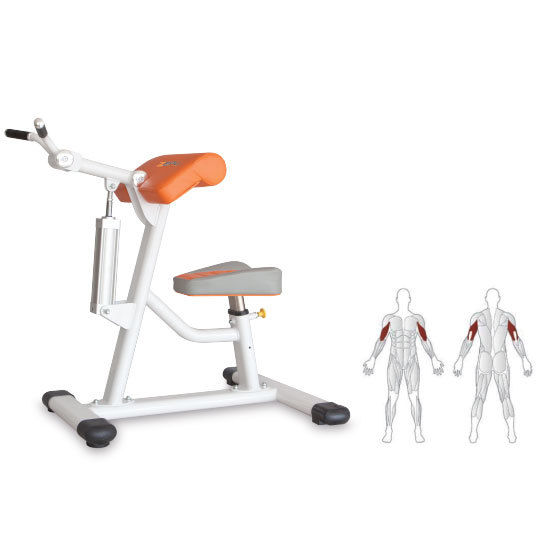
KS109 Back Extension Trainer —Bilateral Hydraulic Trunk Extension Rehab
The AE-KS109 Back Extension Trainer is a clinical-grade bilateral hydraulic trunk extension rehabilitation machine. The KS109 trains the erector spinae (comprising spinalis, longissimus, and iliocostalis), multifidus, quadratus lumborum, and gluteus maximus (extension phase) and loads the abdominals and hip flexors eccentrically (return phase) through two-way hydraulic resistance in a bilateral seated trunk extension movement — the clinical analogue of the machine back extension exercise used in physiotherapy and rehabilitation gym programmes worldwide.
Key Features —
Two-Way Hydraulic Resistance — Safe Spinal Loading from Lowest Limit : The hydraulic resistance mechanism's low-inertia, lowest-limit capability is clinically essential for the KS109's patient populations. The spine is one of the most complex and force-sensitive structures in the human body — sudden inertial loading at the initiation of spinal extension exercise can provoke protective muscle guarding, exacerbate disc pathology, and cause pain in low back pain patients. The KS109's smooth-start, low-inertia hydraulic resistance eliminates this inertial loading risk, enabling back extension training to begin safely even in acutely sensitised low back pain patients, post-spinal surgery patients, and elderly patients with osteoporosis.
The two-way resistance provides:
- Extension phase resistance: Erector spinae, multifidus, quadratus lumborum, and gluteus maximus all loaded concentrically during the bilateral trunk extension — the primary strengthening stimulus
- Return phase resistance: Abdominals (rectus abdominis, obliques) and hip flexors loaded concentrically during the controlled trunk return — training the anterior core in its eccentric role as a trunk flexion decelerator, building the antagonist balance essential for spinal stability
- Bilateral Simultaneous Trunk Extension The KS109 trains bilateral trunk extension simultaneously — developing symmetric paraspinal muscle strength on both sides of the spine. Lumbar extensor asymmetry (one side significantly stronger than the other) is a major contributor to chronic low back pain, spinal torsion patterns, and scoliosis progression in non-structural spinal curves. Bilateral simultaneous training ensures symmetric loading of the paraspinal muscles — correcting the asymmetries that contribute to chronic back pain and postural dysfunction.
- Ergonomic Lumbar Contact Design The KS109's back pad and seat are designed to conform to the natural lumbar curvature — maintaining the spine in its neutral lordotic position throughout the extension movement and ensuring that resistance is applied through the biomechanically optimal extension vector for the lumbar erector spinae and multifidus. This ergonomic lumbar alignment is critical for: avoiding disc-loading positions during exercise in patients with disc pathology; maintaining safe loading patterns in osteoporotic spines; and ensuring that the multifidus — which is most effectively trained in its role as a segmental stabiliser in the neutral spine position — receives maximal training stimulus without being placed in positions that provoke pain or protective muscle guarding.
- Paired with KS108 for Complete Core Rehabilitation The KS109 is designed to be used in clinical sequence with the KS108 Abdominal Crunch Trainer — providing the posterior core training (back extension) that must be balanced by anterior core training (abdominal crunch) for complete spinal rehabilitation. Isolated back extension training without proportional abdominal strengthening creates anterior-posterior trunk muscle imbalance; isolated abdominal training without back extension creates posterior weakness.
Quantity
RELATED PRODUCTS