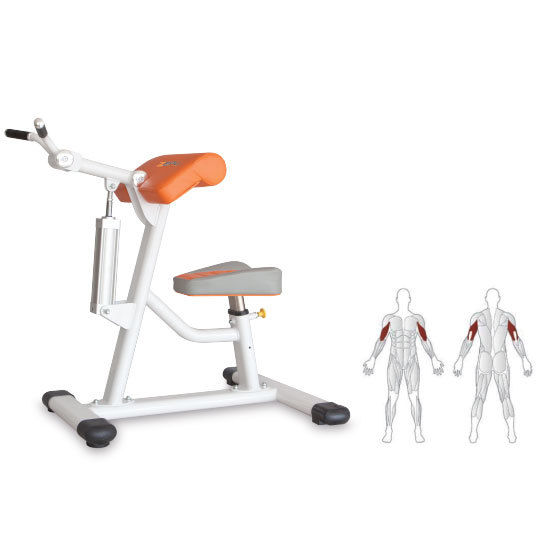
KS108 Abdominal Crunch Gym Station —Cardiopulmonary, Back & Trunk Rehabilitation
The AE-KS108 Abdominal Crunch Rehabilitation Gym Station is a clinical-grade core muscle training machine, reflecting its dual clinical role as a cardiovascular circuit training station and a dedicated trunk rehabilitation device. The equipment is used for bending and stretching of trunk in vertical plane, for chest and back muscle training, and for strengthening the muscle chain of active and antagonistic muscles.
On the premise of ensuring the safety of patients, the KS108 delivers efficient therapeutic training through its two-way hydraulic resistance mechanism — applying controlled, safe, low-inertia resistance to both the trunk flexion (abdominal crunch) and trunk extension (return/back) phases of the movement. This bidirectional loading produces simultaneously the anterior core strengthening of the rectus abdominis and the posterior core conditioning of the erector spinae
Trunk Flexion & Extension in the Vertical Plane — The Training Mechanism :
The KS108 trains the trunk through bending and stretching movements in the vertical plane — the sagittal plane motion of spinal flexion (bending forward) and spinal extension (returning upright) that constitutes the primary functional movement of the trunk in activities of daily living, occupational tasks, and sports performance.
The patient is seated with feet planted on the floor, spine upright, and hands grasping the handles. From this neutral starting position, the patient initiates trunk flexion — bending forward against the hydraulic resistance — bringing the sternum toward the knees through concentric contraction of the rectus abdominis, internal and external obliques, and hip flexors. At the end of the flexion range, the patient reverses direction — returning to upright through concentric contraction of the erector spinae, multifidus, and quadratus lumborum against the hydraulic resistance of the return phase.
Key Features —
Two-Way Hydraulic Resistance — Safe, Progressive Core Loading
The two-way hydraulic resistance system applies therapeutic resistance in both the trunk flexion and trunk extension phases — the defining feature that distinguishes the KS108 from single-direction abdominal crunch equipment where only the forward bending phase is resisted and the return to upright is passively assisted by gravity or springs.
Bidirectional loading — both directions therapeutically loaded:
- The flexion phase (bending forward) — resisted by the hydraulic system — targets the anterior core: rectus abdominis (the primary spinal flexor), internal and external obliques (providing rotational stability and lateral flexion control), and hip flexors contributing to pelvic control during trunk movement.
- The extension phase (returning to upright) — also resisted by the hydraulic system — targets the posterior core: erector spinae (iliocostalis, longissimus, spinalis — the primary spinal extensors), multifidus (the deep segmental spinal stabiliser most critical for intervertebral control), and quadratus lumborum (lateral trunk stabiliser).
This simultaneous anterior and posterior core loading through bidirectional resistance is what makes the KS108 a true trunk rehabilitation station — not simply an abdominal exercise machine. Rehabilitation of the core requires equivalent anterior and posterior chain development to restore the balanced muscular support of the lumbar spine that prevents injury and enables pain-free function.
- Starts from lowest resistance limit — safe for all patient levels: The hydraulic resistance begins at the minimum mechanical limit — enabling severely deconditioned cardiac patients, acute post-surgical patients, and elderly individuals with very limited core strength to begin therapeutic trunk training at genuinely light loads without unsafe force demands on the lumbar spine or cardiovascular system.
- Small inertia — no sudden force spikes: The hydraulic mechanism applies resistance smoothly from the first moment of trunk movement — protecting patients with lumbar spine pathology, post-surgical abdominal healing, and cardiovascular fragility from the sudden loading spikes that inertia-heavy weight stack machines produce at movement initiation.
Quantity
Specifications
| Specification | Detail |
|---|---|
| Exercise Motion | Trunk bending and stretching in the vertical plane (sagittal plane flexion/extension) |
| Resistance Type | Two-way hydraulic resistance — from lowest limit, small inertia |
| Resistance Direction | Bidirectional — both flexion and extension phases resisted |
| Target Muscles | Rectus abdominis, internal/external obliques, erector spinae, multifidus |
| Loading Capacity | ≤ 150 kg |
| Dimensions | 1300 × 740 × 1100 mm |
| Net Weight | 50 kg |
| Ergonomic Design | Joint-stressed parts conform to human morphological principles |
| Training Applications | Cardiopulmonary rehab, core strength, trunk ROM, aerobic, shaping |
| Clinical Indications | Cardiopulmonary rehab, low back pain, core rehabilitation, metabolic disease, sports injury, elderly rehabilitation |
| Setting | Hospital rehabilitation, physiotherapy clinic, cardiopulmonary rehab centre, medical fitness |
| Certifications | CE Certified, ISO Certified |
RELATED PRODUCTS