FlexInFit — Wireless Sensorized Insole System In-Shoe Plantar Pressure Analysis
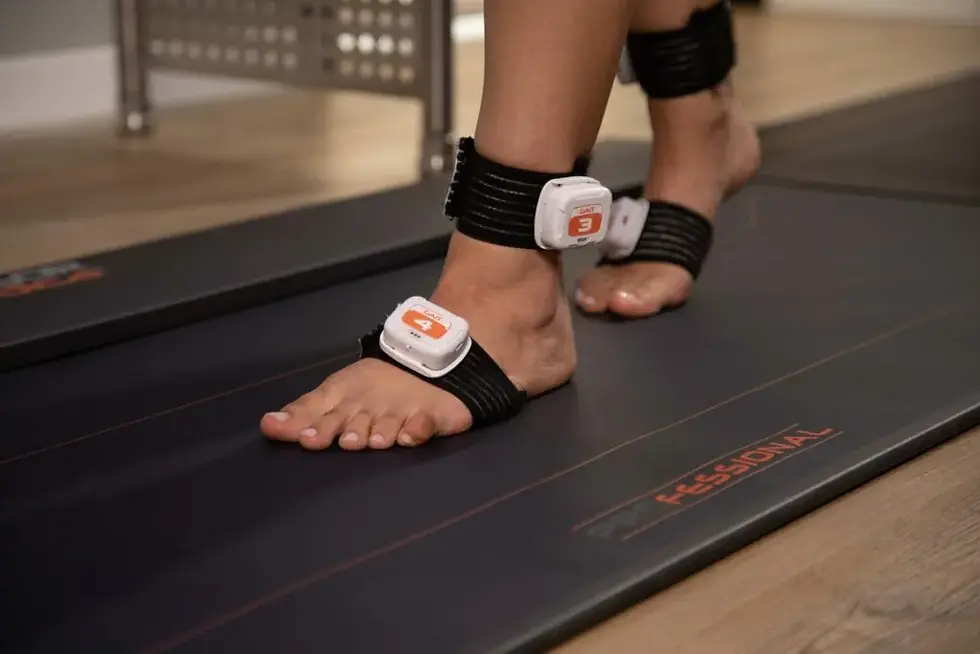
The Sensor Medica FlexInFit is a professional wearable sensorized insole system that places 214 precision pressure sensors inside each insole — and therefore inside the patient's own shoe — delivering the most clinically accurate representation of how the foot actually behaves during real-world activity.
FlexInFit is a completely wireless, junction-box-free, Bluetooth-enabled system that pairs with the freeStep biomechanical analysis software to deliver comprehensive in-shoe plantar pressure mapping, kinetic parameter analysis, gait rocker assessment, Centre of Pressure progression, Gait Line and Butterfly diagram analysis, force vector evaluation, and synchronised video biomechanics — across walking, running, sports activity, and any daily life movement the patient performs.
- 214 Sensors Per Insole — 428+ Total, High-Resolution Pressure Mapping : With 214 sensors per insole — 428 or more sensors across the full pair — the FlexInFit provides a spatial resolution of pressure measurement that captures the fine-grained detail of plantar load distribution that matters clinically.
- Bluetooth Wireless — 100 Metres Range, 4-Hour Continuous Data Logging : The FlexInFit's 100-metre wireless range in free field enables assessment in environments that baropodometric platforms and tethered insole systems cannot reach
- 4-Hour Continuous Data Logging — MicroSD card storage within the insole enables up to four hours of uninterrupted pressure data capture without connection to a computer or external storage.
- Lightweight, Thin, Cut-Out Design — The FlexInFit insole is designed to be cut to the patient's shoe size from a standard insole format and inserted into any shoe — the patient's own training shoes, work shoes, or clinical footwear. The thin profile and lightweight construction ensure that the insole itself does not alter the shoe's fit or the foot's pressure distribution.
Centre of Pressure & Gait Line — Progression and Butterfly Diagram
- Centre of Pressure (CoP) Progression — The CoP path from initial contact through toe-off is rendered as a dynamic trace on the pressure map — showing the specific trajectory of load transfer across the plantar surface during each stance phase.
- Regional Load Percentage — The plantar surface is automatically divided into anatomical regions, and the percentage of total load borne by each region is calculated and displayed.
- Gait Line Analysis — The consecutive CoP traces from multiple steps are overlaid to create the Gait Line — the combined trajectory of load transfer that characterises the patient's habitual gait pattern.
- Butterfly Diagram — The variability of CoP traces across multiple steps is displayed as a butterfly-shaped distribution diagram. Greater variability in the butterfly diagram indicates less consistent neuromuscular control of CoP progression — a measure of dynamic balance quality and neuromuscular stability.
Quantity
Technical Specifications
|
Specification
|
Detail
|
|---|---|
| Sensors Per Insole | 214 |
| Total Sensors (Pair) | 428+ |
| Wireless Connection | Bluetooth |
| Bluetooth Range | Up to 100 metres (free field) |
| Data Logging Duration | Up to 4 hours continuous |
| Data Storage | MicroSD card (internal) |
| Design | Lightweight, thin, cut-out — insertable into any shoe |
| Junction Box | None — completely junction-box free |
| Analysis Software | freeStep |
| Pressure Maps | Average, Maximum, Pressure-Time Integral (HR) |
| CoP Analysis | Progression through stance + % load per foot area |
| Gait Rockers | 4-stage stance phase analysis |
| Butterfly Diagram | CoP variability — lower limb injury risk indicator |
| Force Vector | Kinetic parameters + impact peak analysis |
| Time-Pressure Integral | Hyper-pressure risk factor identification |
| Video Sync | Yes — synchronised with pressure display |
| Video Features | Reference angles/axes + variable playback speed |
| Report | Automatic generation — editable |
| Comparison | Multi-assessment — footwear, orthotics, longitudinal |
| Orthotic Testing | Yes — with or without orthotics inside shoe |
| Ecosystem | freeMed, RunTime, RunTime XL, Podoscan 3D, easyCAD Insole |
Frequently Asked Questions
Q: How many sensors does FlexInFit have?
A: Each individual insole has 214 pressure sensors, giving a total of more than 400 sensors across the pair. This high sensor density enables precise, anatomically detailed pressure mapping across the entire plantar surface of each foot.
Q: Does FlexInFit require cables during use?
A: No. FlexInFit is a wearable, wireless device that connects via Bluetooth — the patient can move freely without any trailing cables, which is essential for capturing natural gait, sports movement, and extended real-world activity.
Q: How long can FlexInFit record data continuously?
A: Up to four hours of continuous data logging — enabling capture of an entire training session, a full working shift, or extended daily activity monitoring, far beyond the single-trial capture typical of laboratory platform-based systems.
Q: Can FlexInFit be used to test the effectiveness of a custom orthotic?
A: Yes — this is one of FlexInFit's primary applications. FlexInFit is a device used in the production of orthopaedic insoles, useful for checking orthotic insoles or for testing their effectiveness directly during the footbed testing phase, allowing direct comparison of pressure distribution with and without the orthotic inside the patient's actual shoe.
Q: Is FlexInFit suitable for diabetic foot ulcer risk assessment?
A: Yes. FlexInFit's time/pressure integral graph specifically identifies risk factors associated with plantar hyperpressures — the cumulative pressure exposure over time that is the primary mechanical driver of diabetic foot ulceration — measured inside the patient's own footwear during real activity.
Q: Can FlexInFit insoles fit any shoe size?
A: Insoles are supplied at a standard maximum size and can be cut to match the individual patient's foot size, allowing the insole to be trimmed for a precise fit inside the patient's own footwear.
Q: How does FlexInFit compare to Sensor Medica's freeMed platform?
A: freeMed measures barefoot plantar pressure on a fixed laboratory platform with extremely high spatial and temporal resolution for precise static, dynamic, and stabilometric analysis. FlexInFit measures pressure inside the patient's actual shoe during real, extended activity — up to four hours — answering questions about real-world footwear performance that a platform cannot address. Many clinics use both technologies together for a complete assessment.
RELATED PRODUCTS