BCI Hand Rehabilitation System - Brain-Computer Interface for Stroke Recovery
The Syrebo SY-BR09 BCI Rehabilitation Training & Evaluation System is the most technologically advanced product in the Syrebo clinical range — and one of the most innovative non-invasive brain-computer interface (BCI) rehabilitation systems available for institutional medical use.
How Non-Invasive BCI Technology Works
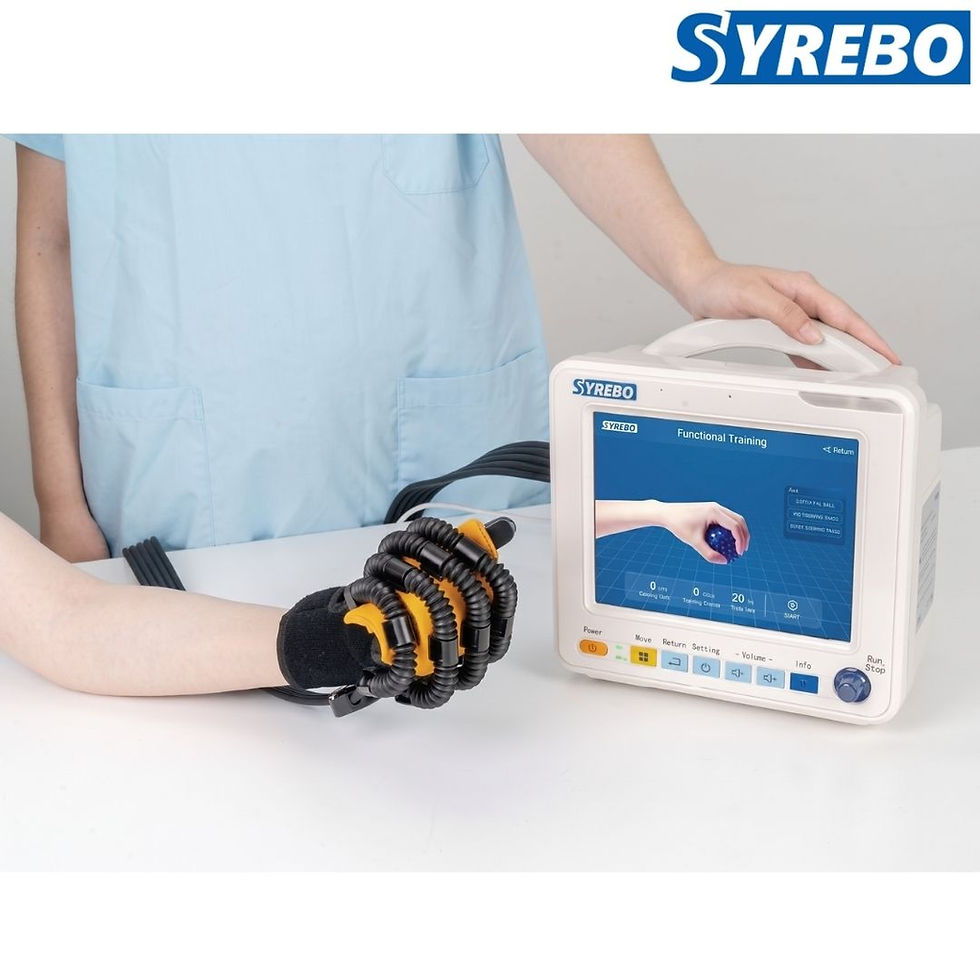
Non-invasive BCI technology works by detecting brain signals linked to movement intention. When a stroke patient tries to move their hand, the brain still generates electrical signals even if no movement occurs. The SY-BR09 captures these signals using an EEG cap. Advanced algorithms analyze them in real time, identify the intended movement, and send commands to a rehabilitation glove. The glove then performs the movement, helping rebuild neural pathways through a continuous intention-to-action feedback loop.
Multi-Dimensional Synchronous Training — 6 Dimensions
Muscle Strength Training — Adaptive assistance/resistance for all strength levels (Grade 0–5).
ROM Training — Improves shoulder and elbow movement across the upper limb.
Cognitive Training — Includes attention, memory, and calculation tasks.
ADL Training — Focuses on daily life activities for functional independence.
Coordination Training — Enhances fine motor and finger control.
Scenario Training — Interactive sessions to increase patient engagement.
Full Rehabilitation Cycle — Muscle Strength Grade 0–5
Passive Mode (Grade 0–1): System moves the hand while EEG tracks intent, helping early neural activation.
Assistive Mode (Grade 2): Detects movement intention and provides support to complete actions.
Active Mode (Grade 3): Patient moves voluntarily with guided assistance.
Resistance Mode (Grade 4–5): Adds resistance to build strength and independence.
Mental Hand Rotation Evaluation System
The SY-BR09 includes a system that assesses and improves motor imagery by having patients mentally rotate their hand. This activates the brain’s sensorimotor network, supporting early motor recovery. It also provides measurable insights into central motor function that traditional physical assessments cannot capture.
EEG Data Recording & Reporting
Continuous Monitoring: Uninterrupted EEG recording during sessions with zero lag.
Easy Data Export: One-click packaging for playback, analysis, and remote consultation.
Progress Tracking: Visual data helps track recovery, identify patterns, and adjust therapy.
Quantity
Why BCI Hand Rehabilitation Robot
Why BCI Rehabilitation Represents the Next Stage of Stroke Recovery
| Parameter | SY-BR09 (BCI) | Conventional Rehab Devices |
|---|---|---|
| Neural signal detection | EEG-based motor intention | No neural monitoring |
| Training initiation | Brain intention-triggered | Passive/external trigger |
| Cortical engagement | Direct — from brain signal | Indirect — peripheral stimulus |
| Evaluation depth | Neural + physical + cognitive | Physical assessment only |
| Training dimensions | 6 simultaneous | 1–3 typically |
| Cognitive integration | Systematic — built in | Optional add-on |
| EEG data for research | Full session recording | No neural data |
| Patient population | Grade 0–5 inclusive | Often limited to Grade 2+ |
| Clinical evidence level | RCT-validated (Huashan) | Varies |
RELATED PRODUCTS